English
 Español
 Русский
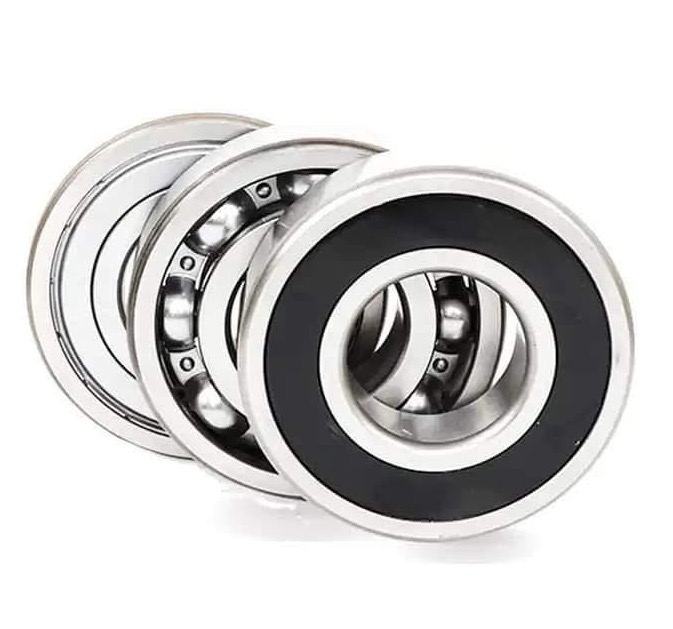
The purpose of the fit in INA bearings is to fix the stationary and rotating rings of the bearing to the stationary part (usually the bearing housing) and rotating part (usually the shaft) of the mounting location, respectively, thereby fulfilling the basic tasks of transmitting loads and limiting the position of the moving system relative to the stationary system during rotation. On shafts and in bearing housings, rolling INA bearings require fixed positions in three directions: radial, axial, and tangential. Radial and tangential positioning is achieved through a tight fit of the bearing rings, while axial positioning is only used in a few cases; generally, axial limiting parts, such as end caps and retaining rings, are used to limit the axial position within the clearance range.
When selecting a fit, the following four points should be emphasized:
1. The circumferential surface of the bearing rings should have good support and uniform stress to reduce deformation and fully utilize the bearing's load-bearing capacity.
2. The rings should not slide tangentially within their mating surfaces, otherwise the mating surfaces will be damaged.
3. It is essential to ensure that the INA bearing is easy to install and disassemble, saving labor, time, and costs.
4. The free end of the INA inlet bearing must be adaptable to changes in the length of the shaft and the INA inlet bearing housing bore; that is, it must have the ability to accommodate axial movement within a certain range.
1. Hand-rubbing method: Rub the lubricating oil between your thumb and forefinger repeatedly. Good lubricating oil feels smooth to the touch, with little wear and no friction. If you feel a strong frictional sensation, like gritty particles between your fingers, it indicates that the lubricating oil contains many impurities and should be replaced.
2. Sunlight method: On a sunny day, use a screwdriver to lift a drop of lubricating oil at a 45-degree angle to the horizontal. Observe the oil droplet against the sunlight. Under sunlight, if you can clearly see no wear and tear in the lubricating oil, it is good and can continue to be used. If there is too much wear and tear, the lubricating oil should be replaced.
3. Oil Drop Trace Method: Take a clean white filter paper and drop a few drops of oil onto it. After the lubricating oil has seeped in, if there is black powder on the surface and it feels resistant to the touch, it indicates that the lubricating oil contains many impurities. Good lubricating oil will not have powder, will feel dry and smooth to the touch, and will leave a yellowish residue.
4. Oil Flow Observation Method: Take two measuring cups. Fill one with the lubricating oil to be tested, and place the other empty on the table. Hold the measuring cup filled with lubricating oil 30-40 cm above the table and tilt it, allowing the lubricating oil to slowly flow into the empty cup. Observe its flow. Good quality lubricating oil should flow in a thin, even, and continuous stream. If the oil flow is inconsistent, with large chunks sometimes flowing down, it indicates that the lubricating oil has deteriorated.